
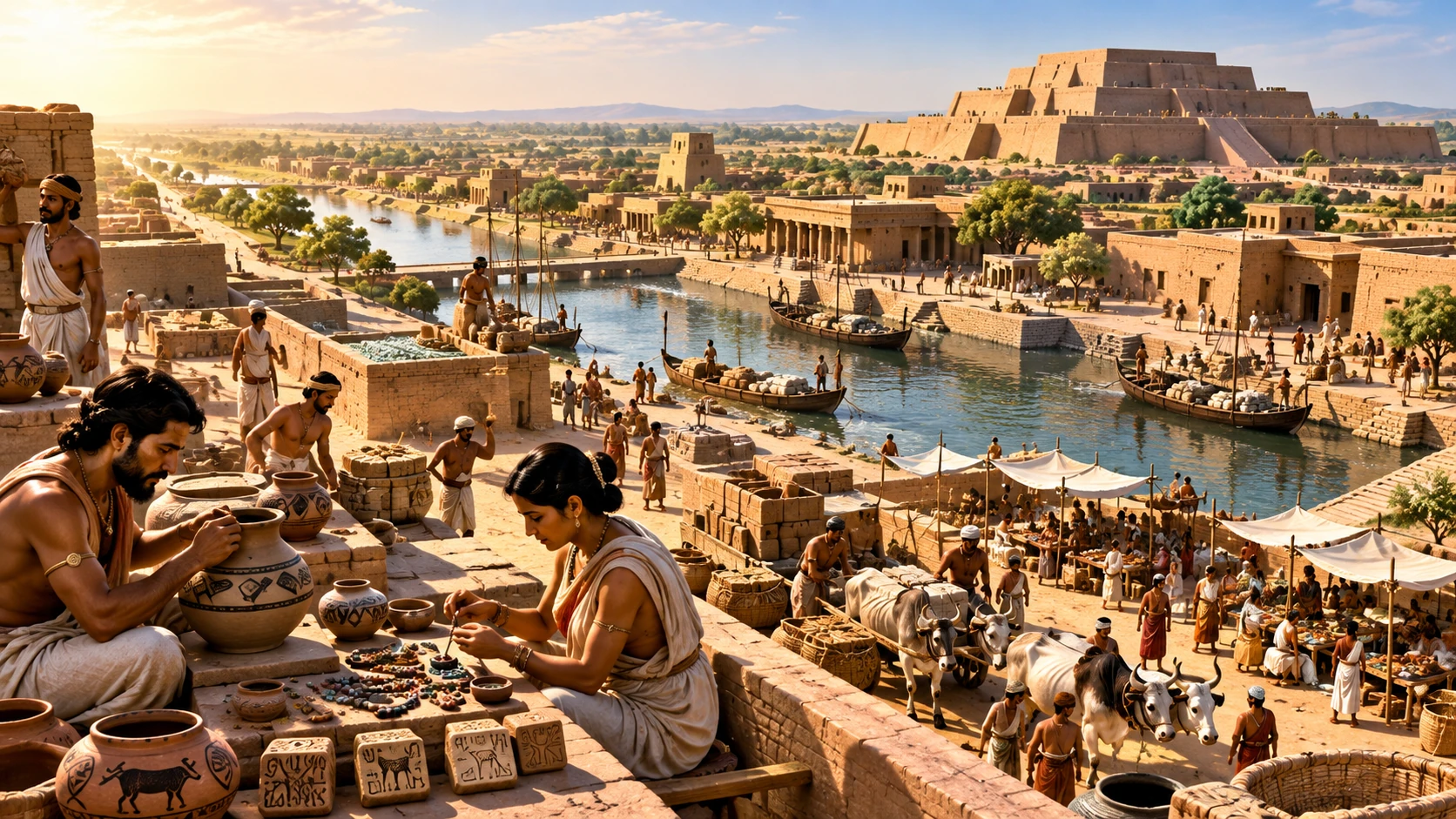
Imagine living in a city with carefully planned streets, organized drainage systems, brick houses, and skilled craftspeople thousands of years before modern technology existed. Around 4,000 years ago, the Indus Valley Civilization was home to thriving communities that demonstrated remarkable knowledge of architecture, trade, sanitation, and urban planning. Also known as the Harappan Civilization, it was one of the great early urban civilizations of the ancient world.
Although many details about its people remain a mystery, archaeological discoveries reveal fascinating clues about their everyday lives, beliefs, occupations, and social organization. Exploring this ancient civilization helps us understand how people built communities and adapted to their environment long before the modern age.
Where Did the Indus Valley Civilization Develop?
The Indus Valley Civilization flourished across parts of present-day Pakistan and northwestern India. Its settlements extended across a large region, including areas near the Indus River and its tributaries.
The civilization’s Mature Harappan period lasted approximately from 2600 BCE to 1900 BCE. Major urban centers included Harappa and Mohenjo-daro, while other important settlements included Dholavira, Rakhigarhi, and Lothal.
Rivers, seasonal rainfall, fertile land, and established trade routes supported many communities. However, the civilization was not limited to riverbanks. Its settlements occupied different environments, demonstrating that people developed varied ways to obtain water, grow food, and conduct trade.
How Did People Live in Ancient Harappan Cities?
One of the most impressive features of Harappan life was urban planning. Many cities had streets arranged in organized layouts, residential neighborhoods, and systems for managing wastewater.
Houses were commonly built using baked or mud bricks, depending on the location and period. Some had several rooms arranged around a courtyard, providing space for household activities and ventilation. Many homes had access to wells, bathing areas, or drains.
Mohenjo-daro is particularly famous for its drainage infrastructure. Wastewater from some houses flowed into street drains, while brick-lined channels and other structures helped manage water and waste.
These features suggest that maintaining clean living spaces and managing water were important aspects of urban life. Nevertheless, archaeologists cannot determine whether every neighborhood had the same facilities or whether all residents enjoyed equal living conditions.
What Did People Eat 4,000 Years Ago?
Agriculture played an important role in supporting Harappan communities. Archaeological evidence indicates that people cultivated crops such as wheat and barley, while regional farming practices also included pulses, sesame, and other plants.
In some areas, evidence points to the use of millets and rice, although the importance of individual crops varied by region and period. Farmers also raised animals, including cattle, sheep, and goats.
Fish, wild plants, and other locally available foods likely supplemented agricultural products in suitable environments. Animals provided food and may also have supported transportation and agricultural work.
Cooking would have taken place using simple hearths and household equipment. Although researchers have recovered pottery, grinding stones, animal bones, and other food-related remains, the precise meals eaten by different families remain difficult to reconstruct.
Clothing, Jewellery, and Personal Appearance
Harappan residents used locally available materials to create clothing and personal accessories. Cotton was known in the region, making the civilization important to the early history of cotton textiles.
People also made ornaments from materials such as shell, copper, gold, semi-precious stones, and beads. Archaeologists have discovered necklaces, bangles, earrings, and carefully crafted beads at several settlements.
The famous figurines and sculptures discovered at Harappan sites offer clues about hairstyles, jewellery, and possible clothing styles. However, these objects do not provide a complete picture of how everyone dressed.
Personal ornaments may have expressed identity, cultural traditions, wealth, or social connections. The variety of materials used in jewellery also reveals the sophistication of Harappan craftsmanship and its links with distant regions.
Occupations, Crafts, and Trade
Life in Harappan cities involved much more than farming. People worked as potters, metalworkers, bead makers, traders, builders, and textile producers.
Specialized workshops and finished objects show that craftspeople possessed considerable technical skill. They manufactured pottery, copper tools, ornaments, seals, and standardized weights used in commercial activities.
Trade connected Harappan communities with other parts of South Asia and regions of western Asia. Archaeological evidence indicates contact with Mesopotamia and other neighboring societies. Goods such as beads, shells, metals, and other valuable materials moved through these networks.
Standardized weights and carefully produced seals suggest that merchants used organized practices to support exchange. Nevertheless, the exact methods of negotiation, payment, and business administration remain uncertain because the Harappan script has not yet been conclusively deciphered.
Religion, Beliefs, and Daily Traditions
The spiritual lives of Harappan people are among the least understood aspects of their civilization. Archaeologists have discovered figurines, seals featuring animals, and structures associated with water and ritual activities.
The Great Bath at Mohenjo-daro is a notable example of sophisticated public architecture. Some researchers interpret it as a place connected with ritual bathing, but its precise purpose is not definitively known.
Certain seals depict figures surrounded by animals, inspiring different interpretations of their possible religious significance. However, it would be misleading to claim that these images prove the existence of a particular god or an established religious system.
Burial practices also varied across sites. Graves containing pottery, ornaments, and other objects provide evidence of how some communities treated their dead, although burial customs alone cannot reveal every aspect of their beliefs.
Why Did the Indus Valley Civilization Decline?
Around 1900 BCE, many major Harappan cities experienced significant changes. Urban centers became less prominent in some regions, long-distance trade patterns shifted, and populations increasingly occupied smaller settlements.
Researchers have proposed several contributing factors, including changing river systems, variations in monsoon rainfall, environmental pressures, and transformations in trade and settlement patterns.
There is no universally accepted explanation for the changes, and evidence does not support a single simple cause for the entire civilization’s decline. Importantly, the decline of large cities did not mean that all Harappan people disappeared. Communities continued living across the region, adapting their farming, settlement, and cultural practices.
Conclusion
The Indus Valley Civilization demonstrates that people 4,000 years ago could build sophisticated cities, develop specialized crafts, establish extensive trade networks, and manage water through carefully designed infrastructure.
Its undeciphered writing system means that many personal stories remain hidden. Yet the surviving buildings, tools, ornaments, and everyday objects reveal a civilization whose achievements continue to attract researchers and visitors today. By studying these discoveries, we gain a deeper appreciation of the creativity, knowledge, and resilience of ancient communities.